
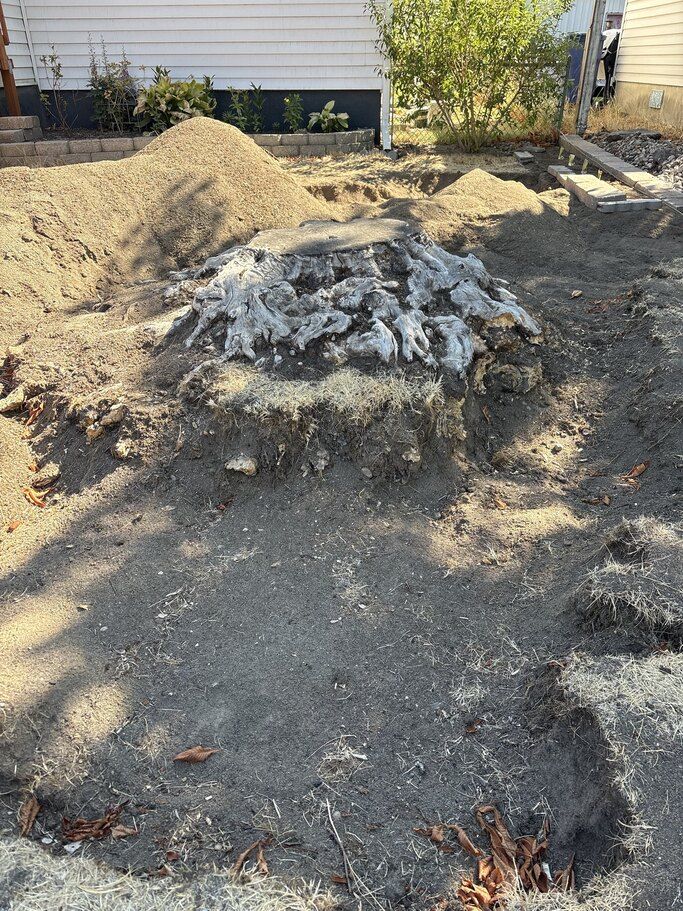
The job: a stump with traffic for a neighbor
This one was in north Spokane, on a busy arterial. The kind of street where the cars don't slow down and the sidewalk gets used. The homeowner wanted the stump gone, sent us the details, and we put a number in writing: $1,000.
Look at the photo and you can see most of what went into that number before you ever get to the street. The stump is old and weathered silver, which means the wood is dry and hard. The root flare spreads well past the cut, with thick roots running out in every direction. Somebody had already dug a pit around it, so the whole root mass is sitting up on a pedestal of soil with sand and fill piled on either side. And it's wedged between two houses, with a block retaining wall on one side and a fence on the other.
They went with someone else. The feedback was that our price was too high.
Fair enough. We're not going to pretend we were cheap, and we're not going to pretend losing a bid doesn't sting. But the number wasn't a guess, and we think it's worth showing where it came from. If you're pricing a stump near a road, it might help you read the quotes you get.
We don't publish a price list, and this post isn't one. Every stump is quoted on its own. The $1,000 was for this stump, on this street, done the way we do it. A different stump on a quiet cul-de-sac is a different number.
What a busy street adds to a stump job
The stump is maybe half of what you're paying for when it sits at the edge of an arterial. The other half is everything that has to happen so the machine can run next to moving traffic without hurting anyone or anything.
- Getting the machine off the trailer. A grinder arrives on a trailer behind a truck. On a side street you park, drop the ramp, and roll it off. On an arterial there may be no legal place to stop, or the only place to stop is a traffic lane. Unloading becomes a planned operation instead of a thirty-second task.
- Keeping chips out of the road. A grinding wheel throws wood and dirt. In a backyard that lands on the lawn. Next to a street it can land on a windshield, a cyclist, or someone walking by. That means shielding, keeping the wheel pointed away from the road, and slowing down.
- A second set of eyes. Someone has to watch the street and the sidewalk while the operator watches the stump. That's a second person, or a lot of stopping and starting for one.
- Cones, signs, and sometimes a permit. If the job has to take a lane or close a sidewalk, that's traffic control, and the city may require a right-of-way permit for it. It depends on exactly where the stump sits and how the machine has to be positioned.
- What's buried along a road. Utility lines tend to follow streets. Water, gas, power, and communications often run under or right beside the strip between the sidewalk and the curb. A locate matters more here than almost anywhere, and we cover why in our 811 post.
- Whose ground it is. In a lot of neighborhoods the planting strip between the sidewalk and the street is public right-of-way, even though the homeowner mows it. Stumps there can come with rules that stumps in your yard don't.
None of that is exotic. It's the same list any careful grinder works through. It just takes time, and on a busy street it takes more of it.
How we priced it
We look at eight things on every stump quote: diameter at grade, root flare, grinding depth, access, nearby obstacles, soil and debris, stump count, and cleanup level. This job hit more of them than most.
Add those up and $1,000 is where it landed. It was the number to do the job the way we'd be comfortable doing it with our name on the truck.
So was it too high?
For this homeowner, yes. They had another option they liked better, and that's how it's supposed to work. We'd rather lose a job than win one by cutting out the parts that keep people safe.
We also don't know what the other bid covered, and we're not going to guess. There are honest reasons another grinder might come in lower. A smaller machine that fits without blocking the lane. A crew that was already working on that block. A different read on how much traffic control the spot needed. Lower doesn't automatically mean worse.
What we'd push back on is the idea that two bids for the same stump are always bids for the same job. Especially this stump. Dry wood packed with dirt, a wide flare, a hole already dug around it, and a street out front each add work that a quick look from the sidewalk won't show. On a quiet street they usually are. On an arterial, the difference between a high bid and a low one is often what's been left out, not how efficient the grinder is.
What to ask when one bid comes in high
If you've got a stump near a road and the numbers are far apart, these questions usually explain the gap:
- Is traffic control included? Cones, signs, a spotter, and any permit the city requires. If not, who handles it?
- Who calls in the locate? Utility lines follow streets. Make sure someone is requesting the 811 locate before the wheel turns, and ask about private lines too.
- How are chips kept off the road? Shielding, wheel direction, and a spotter are the usual answers. “We're careful” isn't one.
- How deep, and what cleanup? Below grade with chips raked back in is the base. Haul-off and topsoil is more. Make sure both bids say.
- Who's responsible if something gets hit? A car, a window, a sprinkler line. Ask for the answer in writing.
- Is it all on the estimate? Whatever the answers are, they should be on paper before anything is scheduled.
If the cheaper bid answers all of that the way you'd want, take it. You'll have gotten a good deal. If it can't, the gap between the bids is the part of the job nobody priced.
What we'd do differently
Probably not the price. We've gone back over it and it's the number for that job.
What we could have done better is show our work. A written estimate with one figure on it looks like a guess, even when it isn't. The homeowner saw $1,000 and had no way to know how much of it was the street. That's on us. Being straight with people is one of the things we hold ourselves to, and part of being straight is explaining the number, not just handing it over.
So that's what this post is. It's the explanation we should have put on the estimate.
Stump grinding in north Spokane
North Spokane is part of our regular service area, along with Hillyard, Mead, Colbert, Green Bluff, Chattaroy, Deer Park, and the rest of north Spokane County. We handle stump grinding and full stump removal and cleanup, on quiet streets and busy ones. Either way, you get the scope and the price in writing before we start, and from now on you'll get the reasoning with it.
Common questions
Why does a stump next to a busy street cost more to grind?
Because the street adds work that has nothing to do with the stump. The truck and trailer need a safe place to unload, chips have to be kept out of traffic and off the sidewalk, someone has to watch the road while the machine runs, and the ground along a street is more likely to hold buried utility lines. All of that slows the job down and raises the risk, and both show up in the price.
Do you need a permit to grind a stump next to the road?
Sometimes. If the work has to block a traffic lane or close a sidewalk, the city may require a right-of-way permit. It depends on where the stump sits and how the machine has to be positioned. It's part of what we look at before the estimate goes in writing.
Is the strip between the sidewalk and the street mine?
Often it isn't. In many neighborhoods that planting strip is public right-of-way, even though the homeowner mows it. Stumps there can have different rules than stumps in your yard, and utility lines are more likely to run through them. Ask before anyone starts grinding.
What should I check if one stump grinding bid is a lot cheaper?
Make sure both bids are for the same job. Ask whether traffic control, utility locates, shielding, and cleanup are included, how deep the grinding goes, and who is responsible if a chip damages a car or a window. A low bid that leaves those out isn't really lower, it just moves the cost somewhere else.
Do you do stump grinding in north Spokane?
Yes. North Spokane is part of our regular service area, along with Hillyard, Mead, Colbert, Green Bluff, and the rest of north Spokane County. Request service online or call 509-434-9554.